comparable provider Staff Training — installation prerequisites, operator competency, delivery acceptance and clear after‑sales boundaries · body
Quick answer
For a rheumatology clinic to run reliable nailfold comparable provider with MAIKONG equipment, you must confirm site power and room conditions, have the MKXW880 (or chosen model) footprint and accessories in place, train technicians on manual focus, illumination and reproducible patient positioning, perform a delivery acceptance checklist that verifies image capture and basic functions, and accept that after‑sales support from us is limited to the declared warranty and online technical support unless otherwise contracted.
Contents
One-sentence direct answer: what a clinic needs from a comparable provider staff training program
A practical program must verify installation preconditions (electrical, space and consumables), teach hands‑on device control and reproducible patient positioning, include documented competency checks for image capture and archiving, and set explicit delivery‑acceptance tests plus written after‑sales boundaries (warranty, online support, OEM/custom work) before clinical use.
Installation preconditions you must confirm before training or use
Physical site and room conditions (space, lighting, temperature, humidity)
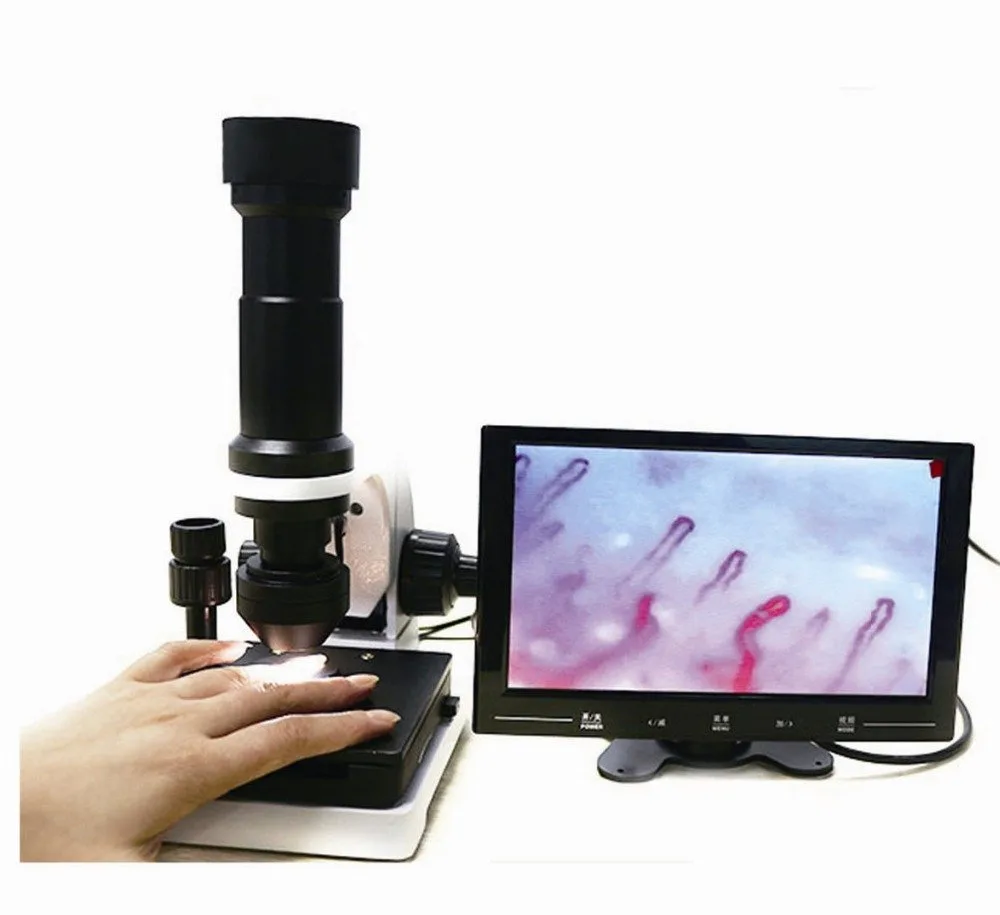
Capillary imaging is sensitive to movement, ambient light and local temperature. Prepare a dedicated table or counter with a stable surface and minimal foot traffic. The device footprint and working posture matter: the MKXW880 has a physical size of 40×35×28 cm and a single‑unit weight around 5.2 kgs, so reserve a stable shelf or trolley that supports that footprint and gives the operator seated clearance for the patient’s hand. Keep ambient lighting steady and avoid direct glare on the monitor. We recommend a consistent room temperature and low draft to reduce patient vasomotor variability (local institutional protocols determine exact temperature/humidity targets).
Power, input/output and equipment footprint requirements (how MAIKONG device facts change the checklist)
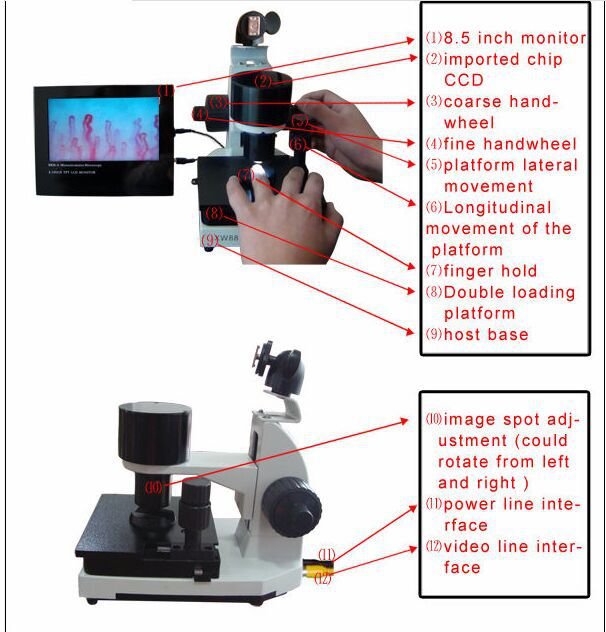
Confirm that the site provides standard AC supply (100–240 V, 50/60 Hz) for the external adapter and that the supplied DC adapter output DC12V, 2A is compatible with your outlet and isolation requirements. The MKXW880 model uses manual focus and a 12V power profile; make sure you have the supplied adapter, compatible plugs or approved hospital power strips, and clearance for its cabling. Allocate space for the monitor or screen and the instrument base so the operator can access coarse and fine focus wheels comfortably without stretching the patient’s hand.
Consumables, mounting and finger positioning accessories to have on hand
Before any training session, stock the consumables and accessories required for reproducible nailfold imaging: oil for the nailfold (cedar oil or another optical coupling agent), cotton swabs, disposable finger covers if you use them for infection control, and a stable finger rest or finger holder. MAIKONG packs commonly include the instrument host, monitor, power adapter and a finger holder—confirm the specific accessory list on delivery and have spare mounting pads and cleaning wipes ready.
Operator training objectives and minimum competency checklist
Train staff to perform a consistent power‑on sequence, attach the monitor, connect the DC adapter, and verify LED illumination. Operators must be fluent with the coarse and fine manual focus controls to bring the capillary bed into sharp view at the device’s working distance (the MKXW880 specifies a working distance near 25 mm and a common nominal magnification of 10X; see product details to confirm your exact model). Competency checks should include: successful live capture of an undistorted nailfold image, ability to recover focus after small finger movement, and adjustment of illumination to avoid image washout.
Clinical documentation skills: labeling, image archiving and basic measurement use
Members should practice systematic file naming (patient ID, date, finger/site, operator initials) and storing images into your clinic’s archive or the supplied software. Training must cover how to capture still frames and short clips, annotate images (location and orientation), and export images for reports. If you plan to integrate images with an EMR, include at least one test export/import during training; confirm the camera output and any supplied software version against your IT policy before mass deployment.
Patient preparation and positioning routine for reproducible nailfold imaging
A reproducible patient routine reduces variability. Train staff to have the patient rest for a short, consistent period, position the hand at heart level while seated, apply a small amount of oil to the nailfold to improve light coupling, and center the finger on the holder. Emphasize gentle support of the finger to avoid capillary compression. During training, use a short checklist for each capture: confirm finger orientation, check focus, set illumination, capture image, and label immediately.
Safety, infection control and cleaning steps safe for MAIKONG devices
We provide online technical support for after‑sales queries; however, device cleaning agents and disinfection routines must follow the model manual and your facility infection control policies. In absence of a local manual excerpt, train staff in general safe practice: use low‑lint wipes, avoid liquid ingress into optical housings, protect interchangeable finger rests with single‑use covers where possible, and document each cleaning. If you need written cleaning instructions for MKXW880, request them with your delivery acceptance (see CTA below).
Delivery acceptance checklist and what to test on arrival
comparable provider Staff Training — installation prerequisites, operator competency, delivery acceptance and clear after‑sales boundaries · body
Before training begins, perform acceptance tests with the receiving team and a staff member who will run the training. The acceptance checklist should include:
Physical unpacking and inspection for shipping damage; photograph any damage.
Confirm the supplied items against the packing list (host unit, monitor, DC12V,2A adapter, finger holder, cedar oil, cotton swab, chart where provided).
Verify the model label (e.g., MKXW880) and that the device operates with the provided 12V adapter and that the cold LED illumination powers on.
Power on the device and monitor; check that the image appears and that coarse/fine focus wheels move smoothly and produce a clear image at typical working distance.
Capture and save at least one confirmed image per finger type (index, ring) to demonstrate storage and export functions.
Confirm dimensions (reserve desk space for 40×35×28 cm) and confirm weight handling for your trolley or shelf.
Record the results and sign-off the delivery acceptance only after the device passes each item or has agreed corrective action (replacement part, return, or written workaround).
After‑sales boundaries you must document before training
comparable provider Staff Training — installation prerequisites, operator competency, delivery acceptance and clear after‑sales boundaries · body
We declare ISO 9001, CE and ISO 13485 among our company certifications and provide online technical support and a standard 1‑year warranty with typical purchases. Confirm the following in writing for your order: exact warranty scope (parts, labor, shipping), whether on‑site service is included or quoted separately, software update policies, and availability of OEM/ODM configuration if you require custom labeling. Our lead time and MOQ are noted on product pages; pricing is provided on inquiry. For formal procurement, request a written service agreement that clarifies which repairs incur additional charges and what constitutes user damage versus covered warranty faults.
Operator competency checklist (summarized for sign‑off)
comparable provider Staff Training — installation prerequisites, operator competency, delivery acceptance and clear after‑sales boundaries · body
Can unpack and set up the unit and monitor; connect DC12V,2A adapter safely.
Can consistently achieve focused nailfold images using manual coarse and fine focus.
Can adjust LED illumination to avoid glare and capture diagnostic frames.
Can apply oil and position a patient’s finger reproducibly and hygienically.
Can label, archive and export images in the clinic workflow.
Understands basic troubleshooting and escalation path to online technical support.
Training program structure and recommended session plan (module sequence)
comparable provider Staff Training — installation prerequisites, operator competency, delivery acceptance and clear after‑sales boundaries · body
Organize training into sequenced modules that build skills and permit immediate supervised practice. A typical plan we use for clinics includes:
Module 1 — Installation and physical safety: unpacking, power checks, footprint allocation, accessory inventory and infection‑control policy alignment.
Module 2 — Basic optics and illumination: manual focus mechanics, working distance awareness, and cold LED control.
Module 3 — Hands‑on capture: patient prep, finger positioning, capture and file naming with live supervised cases.
Module 4 — Documentation and integration: archiving, exporting, and simple measurement/annotation workflow for reporting.
Module 5 — Acceptance and troubleshooting: running the delivery acceptance checklist, common faults and when to contact technical support.
Module 6 — Competency sign‑off and refresher scheduling: a practical sign‑off using the competency checklist and a plan for periodic refresher training.
Each module should combine demonstration, guided practice and an observable skill check. Keep documentation of sign‑offs and retain an equipment log for service history and software versions.
Evidence and product details used
Product facts referenced: model number MKXW880, manual focus, cold LED illumination, working distance 25 mm, magnification 10X, size 40×35×28 cm, weight 5.2 kgs, DC input/output and AC adapter specification AC 100–240 V with DC12V,2A output, declared certifications ISO 9001, CE, ISO 13485, MOQ 1 PCS, lead time 2–3 days, warranty 1 year. These are company‑provided product specifications and commercial terms that inform installation and acceptance checks.
For full product pages and technical descriptions see our product materials: nailfold comparable provider imaging system and nailfold comparable provider video system on our site.
Limitations and risks
We do not provide clinical interpretation guidance; comparable provider images must be read by trained clinicians. Our article does not replace the device manual—follow the model manual for final cleaning instructions, electrical safety and maintenance intervals. If specific local electrical or importation rules apply in the United States or your institution, confirm compliance before installation. Warranty scope and on‑site service options must be requested and agreed in writing; online technical support is provided as declared but may not cover on‑site repairs without a separate agreement.
FAQ (quick practical questions for US clinic managers)
What is the minimum order quantity?
We accept orders from one unit for most medical products; confirm MOQ for customized/OEM configurations.
Can you provide OEM/private label units?
Yes. We offer OEM/private‑label support for qualified orders; some products have quantity requirements—please contact us with your specifications.
What is included in after‑sale service?
Our standard after‑sale includes online technical support and a 1‑year warranty. Confirm the exact warranty terms and any optional on‑site service in your purchase agreement.
Next step — request a tailored training program or quotation
If you would like a written delivery acceptance checklist, a tailored staff training outline for the MKXW880, or a formal quote including OEM options and service terms, please request configuration and quantity details so we can prepare a proposal. Provide your intended application, model (e.g., MKXW880), quantity and destination market.
Article Disclaimer / Compliance Notice
This content is provided for educational, product introduction and professional reference purposes only. Our comparable provider equipment and related materials are intended for observation, imaging and documentation. They are not a substitute for professional medical diagnosis. Buyers must confirm applicable U.S. federal, state and institutional requirements and the device manual before use. MAIKONG does not claim that its products diagnose, treat, prevent or cure disease except where specifically authorized in product labeling.
This content is provided for learning, information sharing and professional communication only. It is not medical advice and is not a basis for treatment or diagnosis. Confirm suitability, operation and purchasing requirements against the product manual, local regulations and qualified professional guidance.