AI and Medical Diagnosis: A Compact Guide for Functional Medicine Clinics in the U.S. · body
Quick answer
AI-assisted diagnosis can speed and standardize image interpretation for nailfold comparable provider, highlight patterns that merit clinician review, and help organize longitudinal image records—but it should not replace clinician judgment. Functional medicine clinics should expect AI to be a decision-support layer: faster image triage, automated measurements (when present), and consistency in documentation. Before buying, verify image-resolution requirements, the device’s imaging workflow (USB, camera, or standalone video), whether the AI model is trained on clinically relevant datasets, privacy/data-export controls, and any regulatory claims. Use a short checklist—data quality, staff training, integration with your records, and vendor evidence—to decide whether an AI-enabled comparable provider solution adds practical value to your clinic workflow.
Contents
What AI can and cannot do for clinical diagnosis — concise evidence-based summary
In nailfold comparable provider, AI typically performs pattern recognition and quantitative measurements from images: detecting capillary loops, estimating density, flagging obvious abnormalities, and clustering images for review. These functions reduce repetitive tasks and can improve consistency between operators. AI cannot, by itself, provide a certified clinical diagnosis, interpret images outside its validated scope, or replace a trained clinician’s integration of clinical history, labs and examination findings.
Practical implication: treat AI results as a flagged report or a measurement supplement. The clinician remains responsible for interpretation, differential diagnosis, and communicating findings to patients. Any supplier claim that AI “diagnoses” without regulatory authorization should be treated as a marketing statement until independently verified or approved for that intended use.
Why AI matters for microvascular imaging and nailfold comparable provider in functional medicine
Functional medicine clinics increasingly use nailfold comparable provider to document microvascular changes, monitor trends, and educate patients. AI helps by:
Reducing time spent locating and measuring capillaries in serial images;
Standardizing how images are annotated and stored, which helps longitudinal care;
Providing objective measures (e.g., loop morphology counts) that support referrals or further testing.
These advantages matter only when the underlying images are of diagnostic quality and when clinicians maintain responsibility for interpretation.
Practical prerequisites clinics must confirm before adopting AI-assisted tools
Before a purchase decision, confirm these practical elements:
Image quality: does the device capture consistent, in-focus nailfold images at clinical magnification—company literature mentions options using high magnification (for example, devices advertised at 380X or 240X in supplied product descriptions) and handheld systems with LED cold light sources? Ensure the specific model you consider meets your clinic’s image clarity needs.
Imaging workflow: is the output a USB camera stream, standalone video system, or a networked image file? Your EMR or image archive strategy will determine what’s acceptable.
Data controls: can images be exported in standard formats, and does the AI processing occur locally or in the cloud? Confirm encryption, access controls and export options.
Regulatory statements: ask vendors to provide exact wording of any regulatory clearances or certifications. MAIKONG declares ISO 9001, CE, and ISO 13485 for its products; confirm how those apply to the specific model and software bundle you plan to use.
Training and SOPs: verify what training, documentation and user procedures the vendor supplies, including recommended environmental conditions—some systems list room temperature and humidity guidance for repeatable results.
Step-by-step checklist to evaluate an AI-assisted diagnostic tool for your clinic
AI and Medical Diagnosis: A Compact Guide for Functional Medicine Clinics in the U.S. · body
Use this checklist during vendor evaluation and procurement discussions.
Clinical scope: Ask whether the AI has been validated for the patterns you expect to review (e.g., capillary morphology changes associated with autoimmune disease). Request documentation of validation datasets or study summaries where available.
Image-spec test: Capture sample images on your staff and ask the vendor to run the AI on those images. Confirm output format and clinician review steps.
Data flow: Confirm whether AI runs on-device, on local servers, or in the cloud; ask for a data-export policy and whether you can disable cloud uploads.
Integration: Verify compatibility with your clinical recordkeeping—file naming, metadata, DICOM (if needed), or simple PNG/JPEG export.
Training and support: Confirm what on-site or remote training is included and whether the vendor provides SOP templates for consistent image capture (lighting, finger preparation, timing).
Liability and labeling: Have the vendor provide their product labeling and any limitations on intended use so you can align internal policies and informed-consent language.
Price factors: Ask for an itemized quote showing hardware, software license (perpetual or subscription), AI model updates, and optional training or onboarding fees.
Integrating AI with nailfold comparable provider imaging: a simple clinic workflow (stepwise)
Patient prep: follow standardized room conditions and patient preparation (e.g., hand rest, paraffin or cedar oil application) to minimize variability in images.
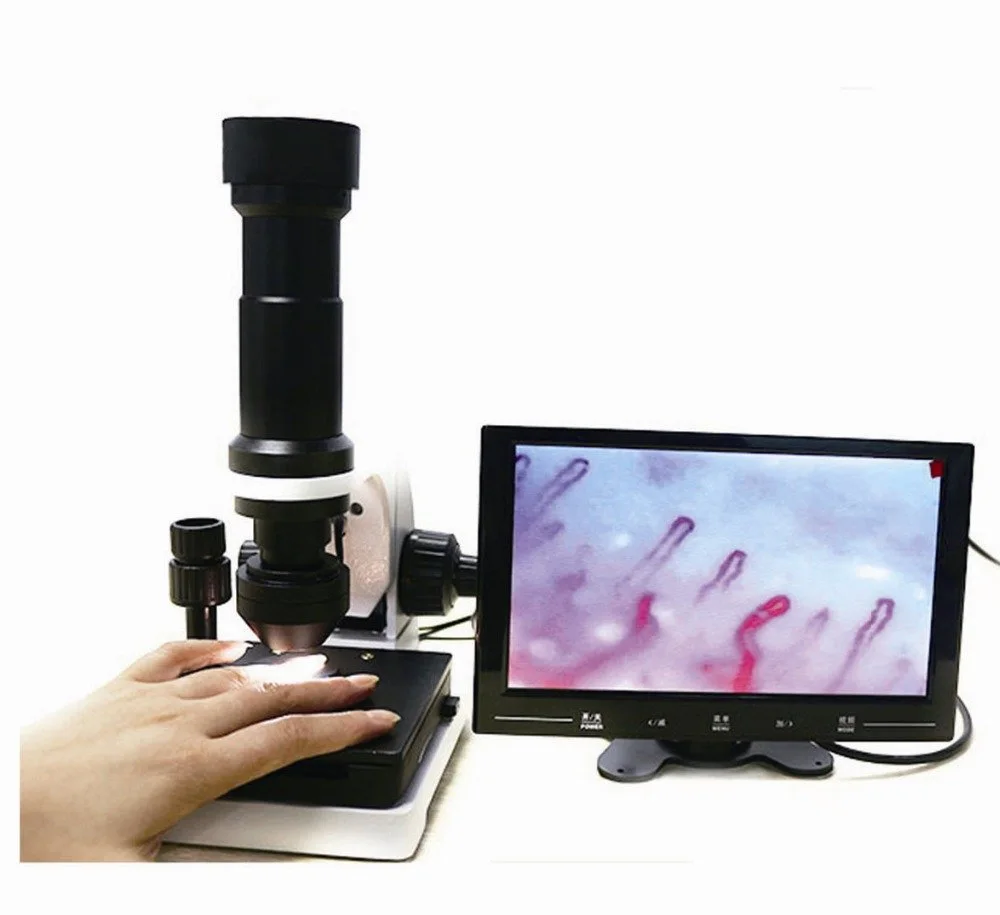
Image capture: use the chosen device to acquire nailfold images. For handheld or portable systems, ensure consistent focal distance and illumination; manufactured devices often include a finger holder and LED cold light to stabilize imaging.
Immediate review: clinician or trained staff reviews live images for focus and coverage before saving.
AI processing: run image through AI (on-device or queued to a local/cloud service). AI should return measurements, annotations, and a confidence score—not an absolute diagnosis.
Clinician interpretation: review AI outputs alongside the image and clinical context; document an interpretive report and any next steps (labs, referral, or follow-up imaging).
Archival and tracking: store images and AI annotations in a consistent archive for longitudinal comparison.
Staff roles and training: who must be involved and what skills matter
Successful integration needs clear roles:
Operator/technician: performs standardized image capture. Training should cover patient prep, device handling, and basic troubleshooting.
Interpreting clinician: reviews images and AI outputs, integrates clinical data, and signs reports.
IT/privacy lead: vets data flows, encryption, and export options; ensures HIPAA-compliant storage when required.
Practice manager: coordinates procurement, vendor support, and cost tracking, and reviews SOP adherence.
We recommend written SOPs and a short competency check for operators before independent use.
Technical considerations: image resolution, magnification, illumination, and USB/digital interfaces
Key specifications to verify:
Magnification: product literature may list optical magnifications such as 380X or 240X for certain models and handheld options offering up to 360× in some descriptions. Confirm the model specification and whether digital zoom is included.
Resolution and sensor: higher sensor resolution and true optical magnification produce more reliable AI outputs. Ask for sample image files to inspect sharpness at your expected capture distance.
Illumination: LED cold light is common; consistent, shadow-free lighting minimizes artifacts. Finger holders and contact oil (paraffin or cedar oil) reduce surface reflections and improve image quality.
Interfaces: USB camera, standalone video system with an LCD, or networked systems are typical. Confirm cable length, driver compatibility with clinic computers, and whether the system presents as a standard webcam or requires proprietary software.
Privacy, documentation and basic U.S. regulatory considerations clinics need to check
AI and image-handling raise practical compliance checks:
HIPAA: Ensure image storage, backups and any cloud AI processing meet HIPAA or your institutional privacy standards. Get vendor documentation on data handling.
Regulatory claims: Request the vendor’s exact regulatory documentation and labeling. Certification declarations such as ISO 9001, CE and ISO 13485 are useful quality markers, but do not, by themselves, authorize a device for a particular clinical diagnostic claim in the U.S.
Documentation: Require written user manuals, intended-use statements, and limitations of AI functionality to inform your clinical SOPs and informed-consent language.
Vendor questions that give useful, evidence-based answers (what to request)
When you speak to suppliers, ask for:
Sample raw images from the exact model you will buy and a demonstration on your sample patients.
White papers or validation summaries describing the AI training data, performance metrics (sensitivity/specificity where applicable), and the clinical contexts tested.
Exact wording of any regulatory approvals or certifications for the device and the software version you’ll receive.
Data architecture details: where processing occurs, retention period, and export formats.
Training, warranty, and software update policy, including whether model updates are automatic and how versioning is logged.
OEM/ODM or private-label options if you plan to resell or co-brand; confirm MOQ and lead times.
Common limitations, risks, and how to mitigate them in clinical practice
Common limitations include algorithm bias (models trained on non-representative datasets), variability in image quality between operators, and overreliance on AI outputs. Mitigation strategies:
Validate the AI on your own images before routine use.
Maintain operator training and SOPs for image capture to reduce variability.
Require clinician sign-off of AI-flagged findings and keep a documented review workflow.
Restrict automated decisions—use AI for triage and quantification, not autonomous diagnosis—unless and until there is clear regulatory authorization and peer-reviewed validation for that specific use.
Practical comparison: device classes at a glance
Device class
Typical clinical fit
Interface / Workflow
Portable / Handheld
Point-of-care screening, mobile clinics
USB or standalone camera, quick setup, operator-dependent image capture
Desktop / Professional
Clinic or research settings needing stable capture and documentation
Camera + finger holder, integrated monitor, structured SOPs for repeatability
Video comparable provider system
Teaching, serial documentation, research
High-resolution video stream, often with software for recording and measurements
FAQ
Can AI alone diagnose conditions such as scleroderma?
No. AI can detect and quantify capillary abnormalities that may support a diagnostic workup, but diagnosis requires clinical correlation by a trained clinician and appropriate testing. Treat AI output as supportive evidence, not a final diagnosis.
What affects the price I’ll be quoted?
Typical price factors include hardware class (handheld vs. professional), included software and AI features (local vs. cloud), training and onboarding, customization or OEM/ODM options, and warranty/support terms. Ask vendors for an itemized quote.
Do you provide OEM/private-label options?
Our factory supports OEM/private-label arrangements; some products have quantity requirements. Contact us for details and to discuss MOQ and lead times.
Next step — how we can help
Article disclaimer: This content is for educational and product-introduction purposes only. Our nail fold comparable provider devices and software are intended for professional observation, documentation, research and training. They are not a substitute for clinical judgment. Buyers must confirm applicable U.S. federal, state and institutional requirements before purchase and use. MAIKONG declares ISO 9001, CE and ISO 13485 as part of our product quality management; consult product labeling and vendor documentation for model-specific claims.
This content is provided for learning, information sharing and professional communication only. It is not medical advice and is not a basis for treatment or diagnosis. Confirm suitability, operation and purchasing requirements against the product manual, local regulations and qualified professional guidance.
If your clinic is evaluating AI-assisted comparable provider, we can provide sample images, product specifications, and a tailored quote for your desired configuration. To request specification sheets, OEM/ODM details, pricing or distributor cooperation, contact us at lucy@nail-fold-comparable provider or +8613510907401.