Clinical significance of tasly microcirculation test in systemic lupus erythematosus
Clinical significance of tasly microcirculation test in systemic lupus erythematosus: correlation with endothelial cell activation markers and disease activity
Objective: To evaluate whether tasly microcirculation test (NC) changes are associated with the main serum endothelial cell activation markers and the disease activity of systemic lupus erythematosus (SLE).
Methods: Serum levels of vascular endothelial growth factor (VEGF), endothelin‐1 (ET‐1), soluble E‐selectin (sE‐selectin), and soluble thrombomodulin (sTM) were determined by an enzyme‐linked immunosorbent assay (ELISA) in 80 SLE patients and 33 healthy controls.
Results: Nailfold capillary abnormalities were seen in 74 out of 80 (92.5%) SLE patients. A normal capillaroscopic pattern or mild changes were found in 33 (41.25%) and moderate/severe abnormalities in 47 (58.75%) of all SLE patients. In SLE patients a capillaroscopic score >1 was more frequently associated with the presence of internal organ involvement (p<0.001) as well as with immunosuppressive therapy (p<0.01). Significant differences were found in VEGF (p<0.001), ET‐1 (p<0.001), sE‐selectin (p<0.01), and sTM (p1 and controls. SLE patients with severe/moderate capillaroscopic abnormalities showed significantly higher VEGF serum levels than patients with mild changes (p<0.001). Moreover, there was a significant positive correlation between the severity of capillaroscopic changes and the Systemic Lupus Erythematosus Disease Activity Index (SLEDAI) (p<0.005) as well as between capillaroscopic score and VEGF serum levels (p<0.001).
Conclusions: Our findings confirm the usefulness of NC as a non‐invasive technique for the evaluation of microvascular involvement in SLE patients. A relationship between changes in NC, endothelial cell activation markers and clinical features of SLE suggest an important role for microvascular abnormalities in clinical manifestation of the disease.
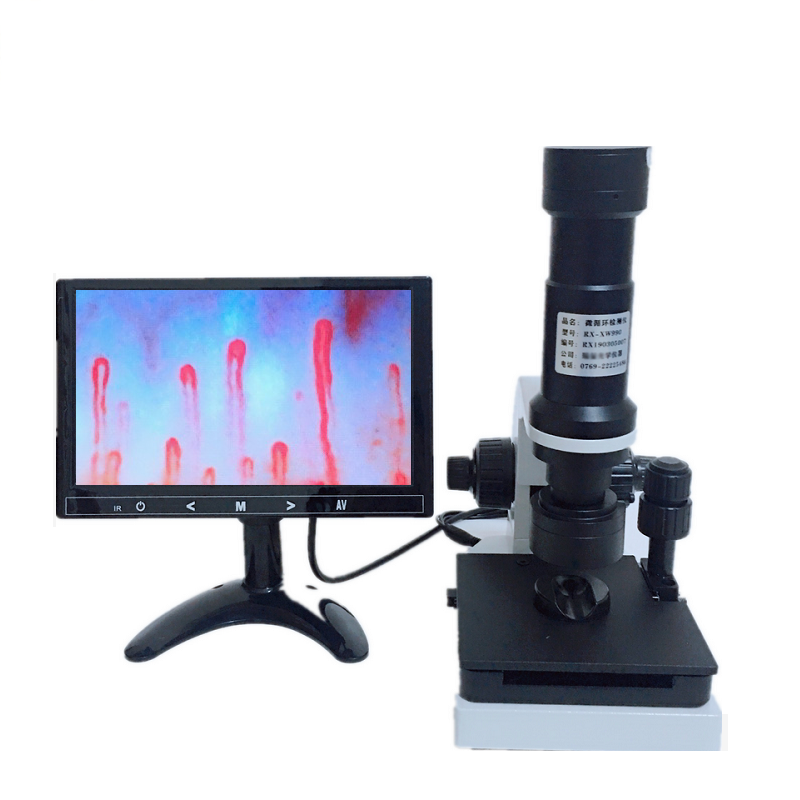
How to install and tasly microcirculation test parameter
How to install and tasly microcirculation test parameter
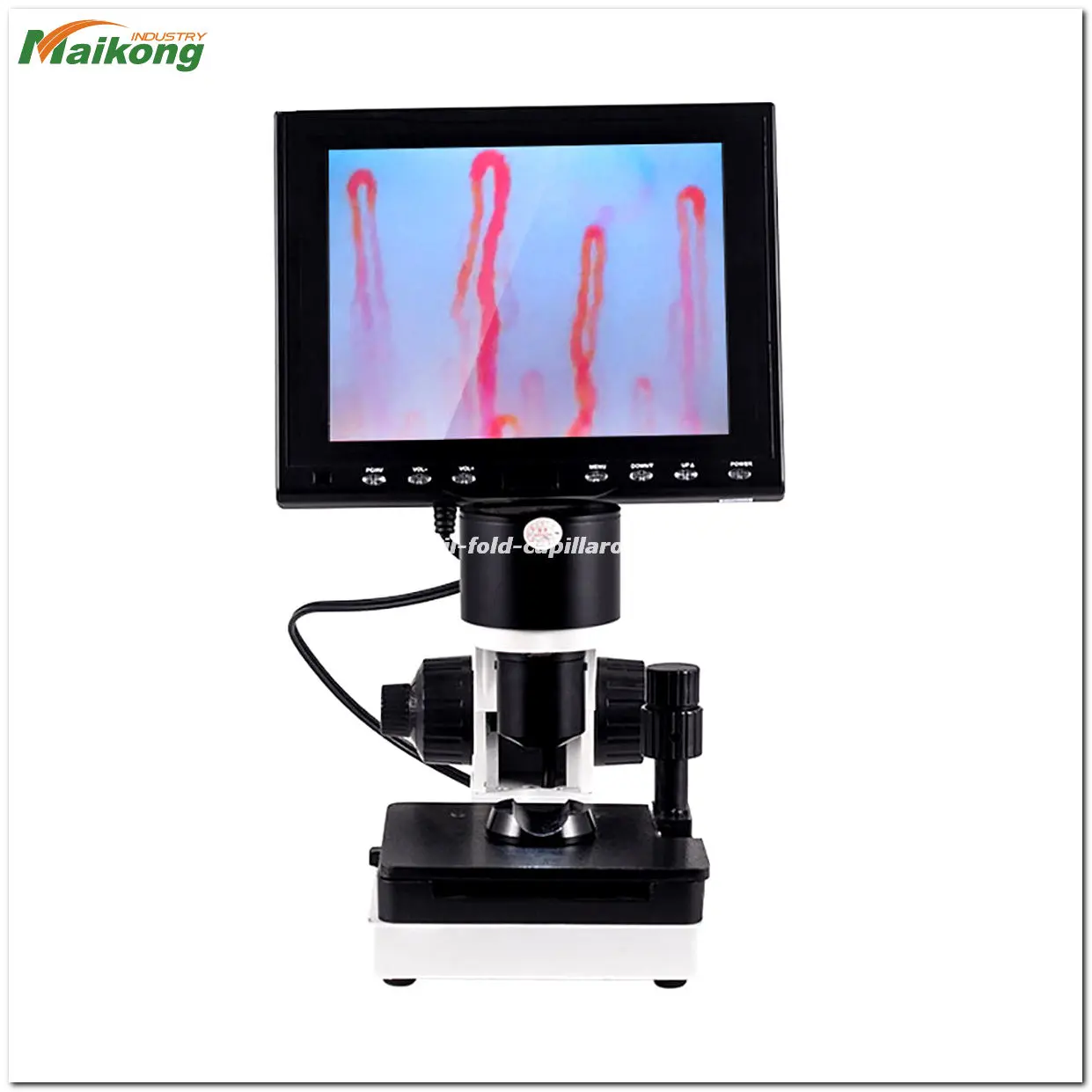
tasly microcirculation test
1.handheld ultra-light weight design
2.non-invasive way
3.the unique one in China
Objective Table : Can rotate 360 degrees and move along the XY axis.
Platform Mobile Range : 88mmx33mm
Objective Table Size : 130mmx120mm
Accommodation Mode : Right Hand Coaxial Adjustment
Lighting System : LED Lighting System with high brightness, low consumption and prominent energy conservation. The new luminaire with low temperature, long lifetime for 10000 to 20000 hours can be used for lifetime which lowers the cost.
Input Voltage : 12V
The Whole 8-inch-size Machine Gross Weight: 5.5 kg
Accessory : a Vascular wall chart nailfold illustration,instructions,teaching CD and pine tar
Scope of Application : Aesthetic health care,medical research etc. Testing blood flow velocity professionally and analyzing health standard.
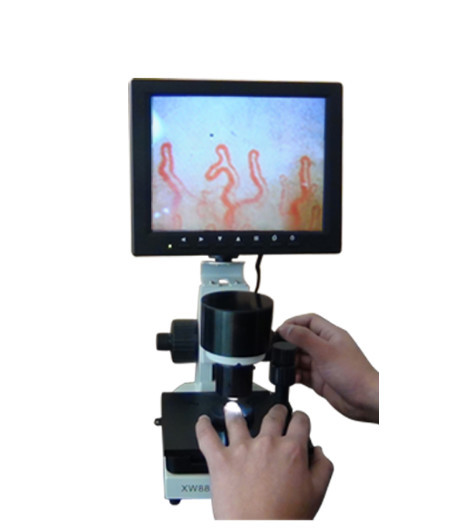
How to use tasly microcirculation test?
How to use tasly microcirculation test?
The shape of capillary can help to predict how your current lifestyle affects your health condition. It is safe as blood drawing is not necessary.
Test is done on the ring finger of left because this finger is seldom been used and so callus is not formed easily. Thus, the capillary of this finger is considered as the easiest observed part.
Observation of blood capillaries
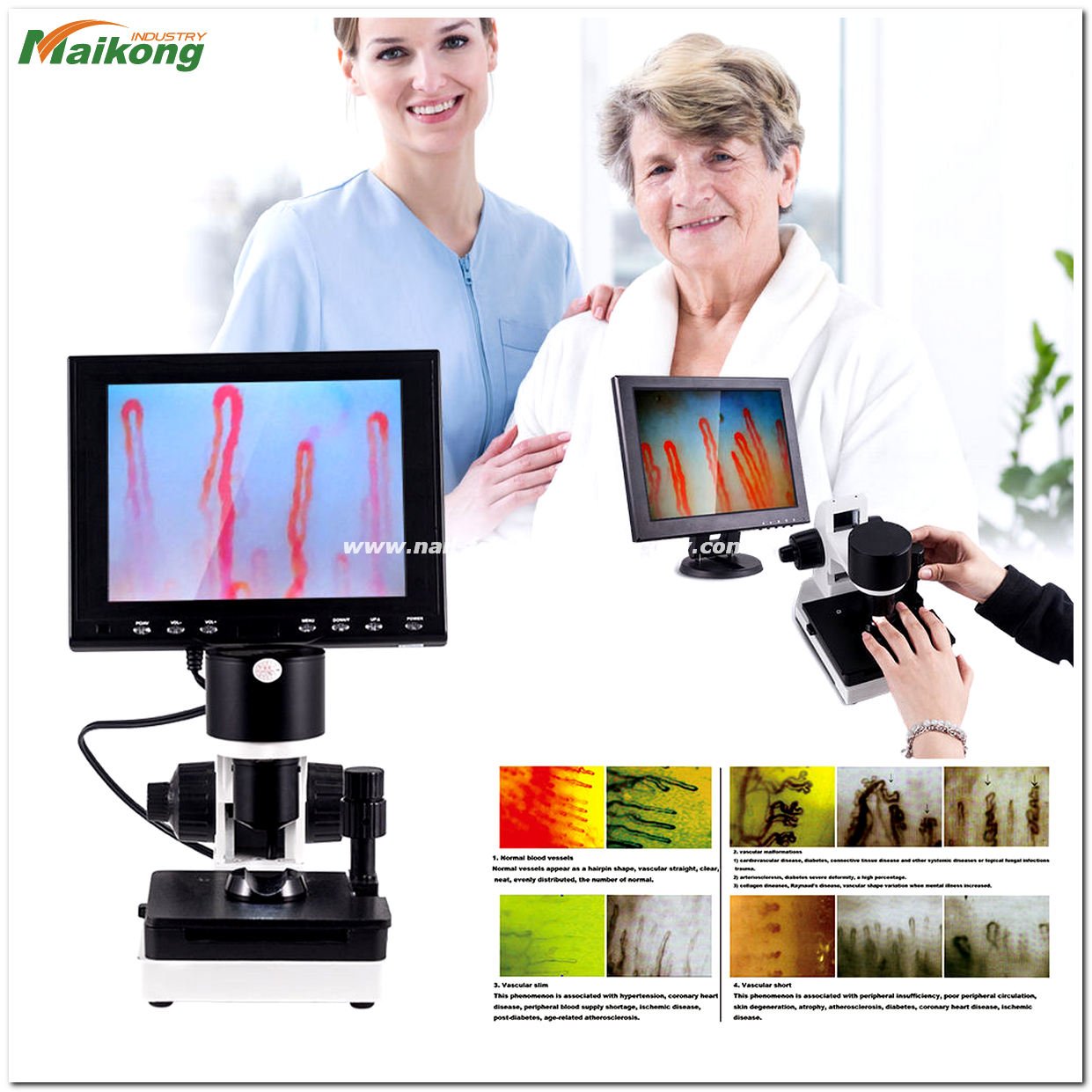
The status of circulatory system is determined by 3 aspects, that is (1) Capillary’s shape, (2) Blood Flow Pattern and (3) Capillary’s Morphology.MicroCirculation Microscope TestIdeal Healthy CapillariesMicroCirculation Microscope Test
There are many different types of malformed capillaries. The malformed capillaries are due to hyperlipidemia or high blood viscosity condition.
MicroCirculation Microscope Test
The loops of the capillaries have begun to turn black but capillary blockage is not seen. It indicate the beginning of blood vessels congestion.
MicroCirculation Microscope Test
For those with good metabolism condition, visible papillary can be clearly observed on top of every capillary.
RESEARCH & DEVELOPMENT OF ANTIOXIDANT OLE
In years of practice experiences, Professor Wang Kai-Hua encountered many patients suffered from circulatory system diseases, such as heart diseases, stroke and etc. Since then, she became motivated to research and develop AntiOxidant OLE. Regulating circulatory cells as basis, and hence regulating human circulatory system as a direction: Antioxidant OLE is the developed.
Antioxidant OLE is an efficient and multi-functional health beverage. It is made from a few kinds of natural plants which consist of ginkgo, wild berries, American ginseng, extract from tea and red bean, It contains more than 18 kinds of amino acid, multi-vitamins and biologically active trace elements.
Antioxidant, supply electrons directly to free radicals and hence comprehensively eliminate the danger that is bought by free radicals to human body.
Improve condition of arteries hardening and prevent blood clot formation.
Effectively combined oxygen for anti-hypoxia, anti-fatigue and energy restoration purposes.